As I sit here wondering when my life will return to normality (hint – never), I’ve realised that it’s been a year since I started chemotherapy. Something I’m still navigating the side effects of.
But I’ve amassed quite a lot of knowledge (unfortunately) and, whilst everyone is different, blah blah, I may have some tips that you’ve not heard of or thought of that may make the chemo journey easier for you or your loved one.
As I’m a woman, I’m going to start with the one that gets us the most.
Hair
I’d love to know why it matters so much, at least for the majority of us. Is it because it’s considered more feminine to have long hair? Is it because we believe we are more attractive with long hair? Are we just vain, or is it a sense of identity?
We chose that style, that colour. It’s who we are. We can change it whenever we want, within reason. A new hairstyle or colour often signifies a new beginning in some way.
The reason is different for everyone, and there are plenty of men who feel the same, just as there are women who couldn’t give a shit.
Whatever your reason, losing your hair – having it fall out in clumps in the shower or finding tufts on the pillow – can be upsetting and traumatic. Some say chemo-induced hair loss is better than “normal” hair loss because you know it will usually grow back. Others feel it’s worse because it’s a symbol of what else is going on.
Cancer.
And, of course, there are other illnesses and medications that can cause hair loss.
I’ve had chemo twice now, over 20 years apart, and my experiences were quite different.
My first experience – 2004
In 2004, my chemo of choice (not that I chose it!) was FEC, which contains epirubicin, one of the red chemotherapy drugs often referred to as the Red Devil. I had thick, shoulder-length hair. I was 35 and single. I did not want to be ugly bald.
I was told, “Use the cold cap, you’ll keep your hair!”
Spoiler alert – this was not how it went.
The Cold Cap
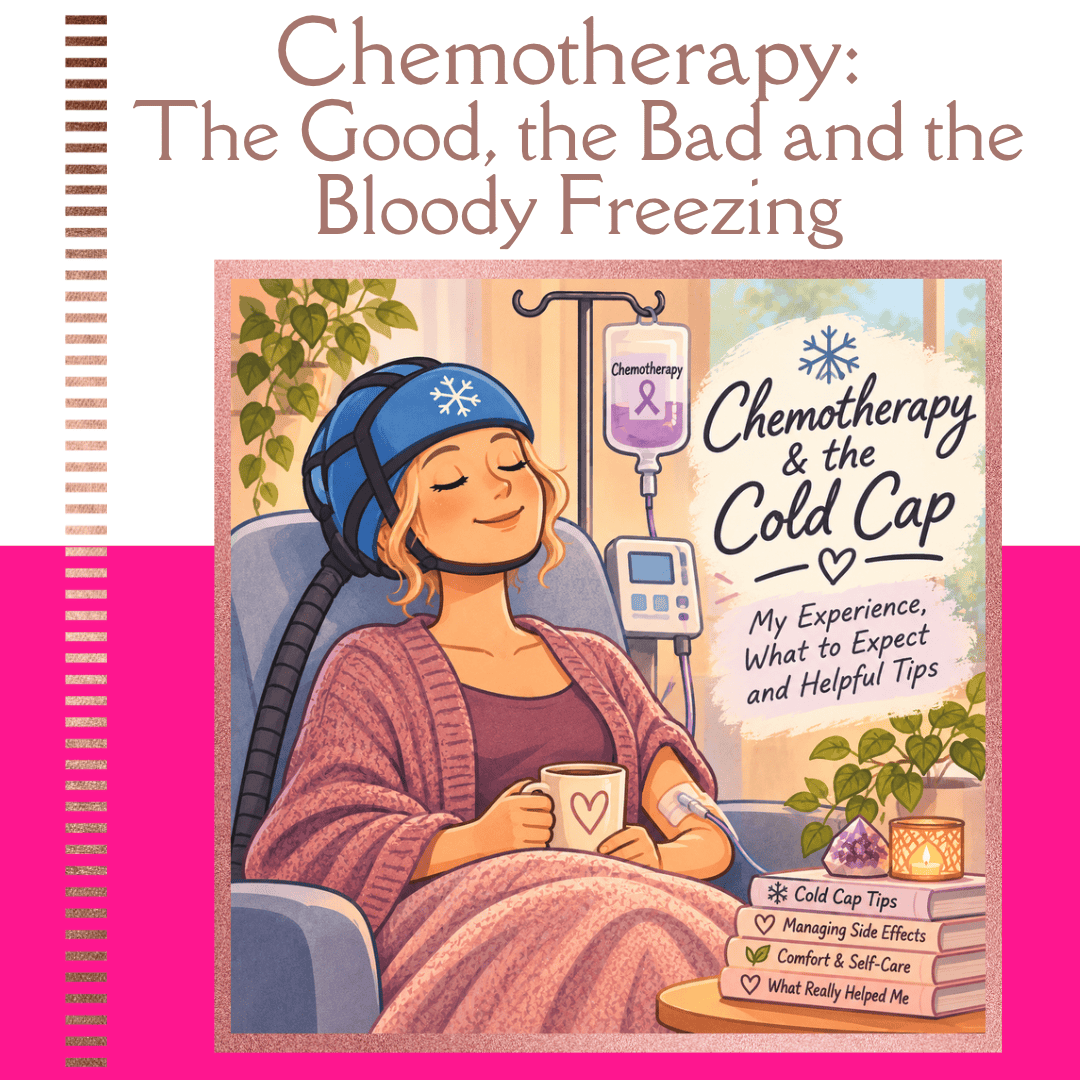
The cold cap, in case you are unaware, is not a World War II torture device, although I have no proof. It is a specially designed cap that cools the scalp before, during and after chemotherapy. The cold reduces blood flow to the scalp and slows down activity within the hair follicles, helping to reduce the impact of chemotherapy on them. I suspect there is a far more scientific explanation available online should you wish to delve further.
So, use the cold cap I did.
A riding cap of ice, tied under the chin, with a towel around my neck. Ever had an ice cream headache? Oh, how I wish that’s what this was like. Many aspects of treatment are a blur, but the memory of screaming for the nurse to take it off and her talking me down has never left me.
To make it worse, my hair started coming out after the first cycle. I was distraught. So I had it cut into a bob.
Cycle 2 – hair continued to fall. I had it cut shorter.
Cycle 3 – still coming out…
When I cried about it at cycle 4, one of the nurses commented that it was because I had too much hair!
Wait, what?
She explained that because I had thick hair, even though it was short, it could be making it harder for the cold cap to cool my scalp effectively. So I cropped it and hoped my follicles would escape the wrath of chemo.
I still lost two-thirds of my hair, but what remained was enough to get me through a hot summer! Wigs were awful back then, and expensive. Not that they’re cheap now, but that’s another story.
The whole experience was painful and traumatic, and I swore never again.
Fast forward to 2025
Crap. Here we go again.
As I’d already received my lifetime allowance of the anthracycline drug in FEC, I was given a taxane-based chemo instead. My hair was longer but thinner – thanks, menopause.
The oncologist said cold caps were better now and that I’d keep my hair. The nurse laughed and said, “No. No, you won’t,” commenting that this particular type of chemo was known to be very harsh on the hair.
Double crap.
I weighed up my options and still did not want to be ugly bald, so I decided to try the cap again, cutting my hair straight away into a chin-length bob. I thought that, with thinner hair, cutting it shorter would be sufficient.
The first cycle was horrendous.
Yes, things have changed. I can acknowledge that. A similar cap design, but with channels within it and a tube at the base that connects to a machine. This machine pumps cooling liquid (my mind thinks antifreeze) on a continuous loop through the cap.
I could feel it flowing, getting frigging freezing, then warming up slightly, then getting colder.
And repeat.
It was hell.
I had to wear the cap for 45 minutes before chemo, throughout the two hours of chemo, and then for another hour and a half afterwards.
I sobbed and decided there was no way I could do this again.
I lost a few strands of hair, slightly more than normal, and was advised not to brush my hair excessively or rough-dry it. However, for many reasons, I decided to crop my hair again.
I hadn’t had short hair since 2004, so it was hard. But I needed to do what I could to keep my hair and convinced myself it would be fun.
I was advised to try to continue with the cold cap as, not only could it help reduce hair loss, but it might also help protect my hair follicles and support regrowth.
The remaining cycles really were fine.
I can’t believe I’m saying that.
But the first was undoubtedly the worst.
I still lost some hair, some of the density, and developed several bald spots on the crown. The back of my hair remained untouched.
Of course it did.
I think the cap fitted more snugly there, so I guess it makes sense.
This time, I bought wigs. Lots of wigs. Lots of colours. Wore some. Sold some. Keeping a few.
Now, a year later, I still have short hair. It grew back fairly thick and curly. The curls may drop as it gets longer, but I’m not in a rush to grow it.
My takeaway
Everyone responds differently. Different chemo, different hair, different experiences.
But, in my opinion, it’s worth a go.
If you feel able to tolerate it, please consider the cold cap if it’s suitable for your treatment. Not only can it help you retain some of your hair, but it may also support better regrowth by protecting the hair follicles.
If you have long or thick hair, bear in mind that a well-fitting cap and good contact with the scalp are important for effective cooling.
My cold cap tips
- Consider your hair type and the fit of the cap
Scalp cooling can help reduce hair loss, but the cap needs to fit snugly and cool your scalp evenly to work effectively. Speak to your chemo team about preparing your hair and getting the best fit. You don’t necessarily need to cut your hair.
- Allow extra time
Having the cold cap will add time to your chemo appointment, as you need to wear it before, during and after your treatment. How long will depend on your particular chemotherapy regimen and cooling system.
- Consider pain relief
The cap is cold and can be painful, particularly when it’s first put on. Ask your chemo team whether you can take some suitable pain relief before you start.
- Be realistic about the results
Be prepared for the cap not to work as well as you’d hoped. It doesn’t work for everyone, even if you do everything right.
- Don’t judge the entire experience by your first session
My first session was horrendous, but the subsequent sessions were so much more manageable. Equally, if you decide it’s not for you, that’s absolutely fine.
- Wrap up warm
Take a blanket and a scarf to help keep you warm.
- Take a flask of something hot!
A hot drink can be a welcome comfort when you’re sitting there freezing.
And remember, whether you choose to cold cap or not, whether you lose some of your hair or all of it, it is your experience, your hair and your decision.